
What Makes an Expert Running Physio? Advice for Melbourne Runners
Running is one of the most accessible forms of exercise — but when injuries set in, it stops feeling simple very quickly. For recreational and competitive runners across Croydon, Ringwood, and the Yarra Ranges, finding a physiotherapist who genuinely understands running makes a meaningful difference to how quickly you recover and how well you stay on your feet long-term.
So what actually separates a running-focused physiotherapist from a generalist? And what should a running assessment involve? This article covers what we look for, how we approach running injury management, and why the goal is almost always to keep you running — not take it away from you.
Running Injuries Are Different
Running injuries are rarely the result of a single incident. Unlike a sprained ankle from a football tackle or an ACL injury from a pivot, most running injuries develop gradually — the product of cumulative load on tissues that weren’t adequately prepared for the training demands placed on them.
This means the approach to assessment and treatment has to be different too. Understanding why the injury developed matters just as much as understanding what structure is involved. A runner presenting with Achilles pain needs a different conversation than someone who rolled their ankle — the training history, load changes, footwear, terrain, and strength profile are all part of the picture.
Common running injuries we regularly assess and treat include Achilles tendinopathy, ITB syndrome, patellofemoral pain, shin splints, plantar fasciitis, proximal hamstring tendinopathy, calf strains, and stress injuries. Many of these share a common thread: the training load exceeded what the body was conditioned to handle at that point in time.
What a Running-Specific Assessment Actually Involves
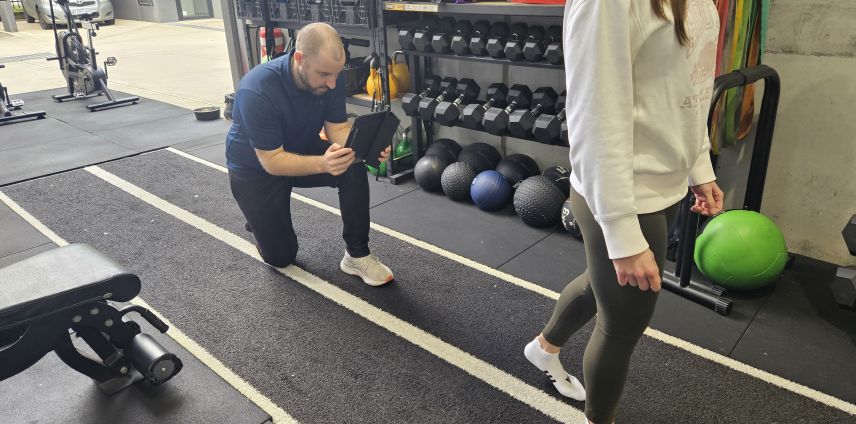
A good running assessment goes well beyond pressing on the sore spot. At Adapt Sports Physiotherapy, we take a structured approach that covers several layers of information:
Training load history — how much you’ve been running, how that’s changed recently, the surfaces you train on, and whether any other training variables have shifted. A sudden jump in weekly kilometres is one of the most reliable predictors of overuse injury, and it’s often the piece of the puzzle that gets overlooked when people focus only on the painful structure.
Movement quality and strength testing — we assess hip, glute, and calf strength, single-leg control, and lower-limb mechanics. Strength deficits in these areas are among the most common contributing factors to running injuries, and they’re also highly trainable — which means identifying them creates a clear target for rehabilitation.
Gait assessment — where clinically relevant, we observe how you run. This doesn’t mean prescribing a dramatic overhaul of your form — running gait changes are generally reserved for specific situations where a technique factor is clearly contributing to the injury. But understanding how you move informs the overall picture.
Load capacity versus load demand — the central question in most running injury presentations is whether the tissue is being asked to do more than it’s currently capable of. Building a program means understanding that gap and creating a bridge between where you are now and where you need to be.
The Modify-Don’t-Stop Philosophy
One of the most important things we communicate to injured runners is that stopping entirely is rarely the right answer. Unless you have a stress fracture, significant structural injury, or pain that prevents comfortable weight-bearing, some form of running can almost always continue. The question is what volume, intensity, and surface is appropriate given your current situation.
Modifying rather than stopping matters for several reasons. Continued load — at appropriate levels — supports tissue healing and maintains the conditioning you’ve built. It also keeps you mentally connected to your training, which matters more than people often acknowledge when they’re frustrated by injury.
Practical modifications might include reducing weekly kilometres temporarily, switching to flatter terrain, breaking runs into shorter sessions, substituting some runs with pool running or cycling to maintain cardiovascular fitness, or adjusting pace. The right answer depends on the injury and where you are in the training cycle. Our running injuries service page covers the conditions we commonly treat and our overall approach to management.
Strength Training for Runners
Many runners underestimate how central strength training is to both injury prevention and performance. Glute weakness, poor hip abductor control, and limited calf capacity are among the most frequently identified contributors to running injuries — and they respond well to targeted, progressive strength work.
This doesn’t mean runners need to become weightlifters. It means building the specific strength qualities that support running mechanics: single-leg stability, hip control through the stance phase, and the calf and Achilles capacity to handle the load of repetitive push-off. When these qualities are adequate, the body is significantly better equipped to handle training loads without breaking down.
A good strength program for a runner is designed around running demands — not generic gym programming. The exercises, loads, and progressions are chosen to complement training, not compete with it, and they’re adjusted as the runner’s capacity improves.
Return to Full Running After Injury
Returning to full training after a running injury should be a structured, progressive process — not a binary switch from rest to normal training. We use a return-to-running framework that accounts for pain response, tissue load tolerance, and the runner’s goals and timeline.
For most overuse injuries, this involves a period of reduced load followed by a gradual re-introduction of running volume. For more significant injuries such as stress fractures or major tendon presentations, the timeline is longer and the progressions more conservative. In both cases, strength benchmarks and symptom response during and after running guide the pace of return — not the calendar alone.
For runners dealing with shin pain specifically, it’s worth understanding the difference between shin splints and a stress fracture — the management approaches are very different. Our guide on shin splints vs stress fracture explains the key differences and what each requires. For a broader overview of running injury management, see our running injuries guide.
Serving Runners in Croydon, Ringwood and the Yarra Ranges
Adapt Sports Physiotherapy is based in Chirnside Park, close to Croydon and Ringwood, and we regularly see runners from across the Yarra Ranges — from casual joggers managing their first injury to competitive athletes building back from significant setbacks. Whether you’re training for a half marathon, running for fitness, or trying to figure out why the same knee keeps flaring up every time you increase your load, a structured assessment gives you a clear picture of what’s happening and what to do about it.
The sooner a running injury is properly assessed, the more options you have. Most running injuries that are caught early can be managed without significant time off. The ones that become chronic or recurring are usually the ones that were pushed through or managed with rest alone without addressing the underlying cause.
Frequently Asked Questions
Do I need to stop running completely when I’m injured?
In most cases, no. Unless there is a stress fracture, significant structural injury, or severe pain with weight-bearing, some form of running can usually continue — modified in volume, intensity, or surface. The goal is always to keep you moving in a way that allows healing rather than stops it. (General information only.)
What should a running physio assessment include?
A thorough running assessment should cover your injury history, current training load, movement quality, lower-limb strength, and where possible a gait assessment. Understanding the relationship between your training and your symptoms is just as important as identifying the tissue involved. (General information only.)
How important is strength training for runners?
Very important. Strength deficits — particularly in the glutes, hip abductors, and calf complex — are among the most common contributors to running injuries. A structured strength program tailored to running demands is one of the most effective ways to reduce injury risk and improve performance. (General information only.)
How long does it take to recover from a running injury?
Recovery time varies significantly depending on the injury type, severity, and how it’s managed. Mild overload presentations can settle within a few weeks with load modification. Tendinopathies and stress injuries typically take longer and require a structured progressive program. Individual timelines vary. (General information only.)
Can I see a running physio even if I’m not injured?
Yes. A running assessment can identify movement and strength factors that may increase injury risk before symptoms develop — which is particularly useful when building up to a race, returning from a break, or increasing training load. (General information only.)