
Ankle Sprain Treatment: What to Expect at Adapt
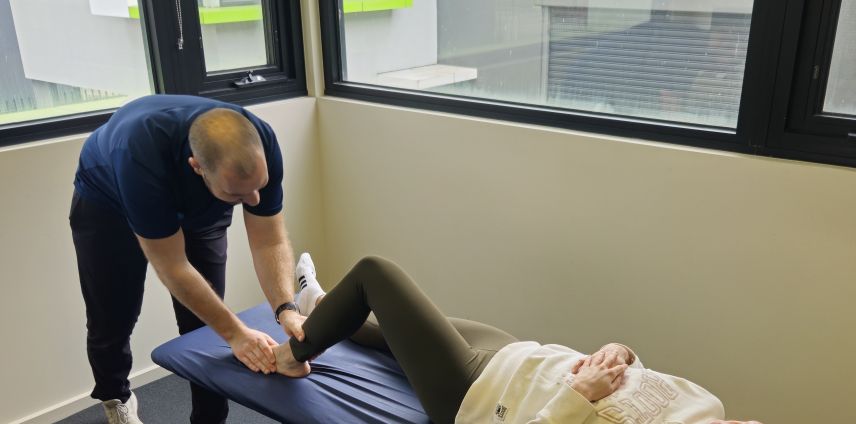
Ankle sprains are among the most common injuries in sport and daily life — and one of the most frequently undertreated. Whether it happened during a football game in Chirnside Park, a trail run near Croydon, or a basketball match in Ringwood, the temptation to “walk it off” and return to activity too soon is understandable but often costly.
Poor initial management and incomplete rehabilitation are the main reasons people end up with chronic ankle instability and repeated sprains. This guide explains what to do, what to expect, and how to recover properly.
What Happens When You Sprain Your Ankle?
The most common ankle sprain is a lateral (outer) ankle sprain — where the foot rolls inward and the ligaments on the outside of the ankle are overstretched or partially torn. The anterior talofibular ligament (ATFL) is the most frequently injured, followed by the calcaneofibular ligament (CFL) in more severe sprains.
Sprains are graded by severity:
- Grade 1 (mild): Minor ligament stretch without tearing. Some tenderness and swelling. Usually weight-bearing is possible.
- Grade 2 (moderate): Partial ligament tear. Significant swelling, bruising, and tenderness. Walking is painful.
- Grade 3 (severe): Complete ligament rupture. Marked instability, extensive swelling and bruising. Weight-bearing may not be possible.
What to Do in the First 24–72 Hours: The PEACE & LOVE Framework
Current best practice for acute ankle sprains follows the PEACE & LOVE framework — replacing the older RICE and POLICE protocols. PEACE covers the immediate phase (Protection, Elevation, Avoid anti-inflammatory modalities, Compression, Education); LOVE covers the days and weeks that follow (Load, Optimism, Vascularisation, Exercise).
In practice for an ankle sprain, this means:
- Protect the ankle from further injury — tape, a brace, or crutches if needed in the first 1–3 days while acutely painful
- Elevate the leg above heart level when resting to reduce swelling
- Avoid ice and NSAIDs — both are no longer recommended in the acute phase, as they can interfere with the natural inflammatory response that drives tissue repair
- Compress with a firm bandage or compression wrap to manage swelling and provide support
- Educate yourself about the injury — understanding the expected recovery process reduces anxiety and supports an active approach to rehabilitation
- Load the ankle early with controlled, pain-guided movement and weight-bearing rather than complete rest
- Vascularise with gentle movement, walking, and low-load activity to promote blood flow to healing tissue
- Exercise progressively — range of motion first, then strength, then proprioception and sport-specific work
The Most Undertreated Part: Proprioception Rehabilitation
Swelling resolves. Bruising fades. Pain improves. And many people stop there — returning to sport before their proprioception (joint position sense) and balance have been fully rehabilitated. This is the most common reason ankle sprains recur.
When you sprain your ankle, you damage not just the ligament fibres but also the sensory nerve endings within those ligaments that tell your brain where your ankle is in space. Without rehabilitating these systems, the ankle remains vulnerable to re-injury even once it feels “fine.”
Proprioception rehabilitation involves progressive balance training — starting with simple single-leg standing and advancing to dynamic balance on unstable surfaces, sport-specific movements, and agility work under fatigue. For athletes, this stage should replicate the demands of their sport before they return to it.
This is why a physiotherapy-guided rehabilitation program produces consistently better long-term outcomes than simply waiting for pain to resolve. Tissue healing and functional recovery are not the same thing — and confusing the two is the most common reason ankle injuries recur.
Return to Sport Criteria
Before returning to training or competition, athletes should generally be able to:
- Walk and jog without pain or altered gait
- Perform single-leg calf raises without pain
- Balance on the injured leg for 10+ seconds without significant instability
- Complete sport-specific agility movements without pain or compensation
- Sprint in a straight line and then with change of direction without pain or instability
For basketball and court sport athletes specifically, see our guide to ankle injuries in basketball.
When to See a Physiotherapist
Seek assessment if:
- You cannot weight-bear on the ankle immediately after the injury or after the first 24 hours
- Swelling is significant or rapidly increasing
- There is bony tenderness (not just soft tissue tenderness) around the ankle or foot
- You’ve sprained the same ankle before and want to avoid chronic instability
- Symptoms are not improving after 5–7 days of self-management
Note: Bony tenderness may indicate a fracture, which requires imaging to exclude. The Ottawa Ankle Rules — a widely used clinical guideline — help determine when X-ray is warranted. Your physiotherapist can apply these criteria and refer for imaging where appropriate.
We work with athletes from Chirnside Park, Croydon and Ringwood who’ve rolled their ankle at sport, on the trail, or in daily life. Our foot and ankle physio service covers everything from acute sprain management through to chronic ankle instability rehabilitation. If heel or foot pain is part of your presentation, our guide to plantar fasciitis and heel pain is also worth reading.
Chronic Ankle Instability: When It Keeps Coming Back
If you’ve sprained the same ankle two, three, or more times, you may be dealing with chronic ankle instability — a condition where the ligaments haven’t been adequately rehabilitated and the joint’s neuromuscular protection system remains compromised.
Chronic ankle instability is not just bad luck or a weak ankle you have to live with. It’s a well-understood consequence of incomplete rehabilitation that responds well to structured physiotherapy in most cases. The key components of rehabilitation are progressive ankle strengthening, balance and proprioception training, and progressive return to sport-specific loading — the same components that should have been addressed after the original injury.
Athletes with chronic instability also benefit from external support (bracing or taping) during return to sport to reduce re-injury risk while the neuromuscular system is being rebuilt. Surgery is typically reserved for cases where thorough physiotherapy rehabilitation has not produced adequate stability.
Frequently Asked Questions
Should I get an X-ray after an ankle sprain?
The Ottawa Ankle Rules are a clinical guideline used to determine whether X-ray is necessary after an ankle injury. Key indicators include: inability to weight-bear immediately after injury or in the clinic, and bony tenderness at the tip of the fibula, the base of the 5th metatarsal, or the navicular bone. Your physiotherapist can help determine if imaging is needed. (General information only.)
How long does an ankle sprain take to heal?
Grade 1 sprains typically recover in 1–2 weeks. Grade 2 sprains usually take 3–6 weeks. Grade 3 sprains can take 3–6 months depending on instability and rehabilitation commitment. Return to high-level sport often takes longer than people expect. (General information only.)
Can I tape my ankle instead of seeing a physio?
Taping provides support and proprioceptive feedback but does not address the underlying ligament healing or the proprioceptive deficit that develops after a sprain. If you’re taping to manage symptoms at sport, a physiotherapy assessment is still recommended to ensure you’re rehabilitating the ankle properly. (General information only.)
I’ve had multiple ankle sprains — is surgery the only option?
Chronic ankle instability from repeated sprains often responds well to structured physiotherapy rehabilitation, even after multiple injuries. Surgery is generally considered after a thorough course of physiotherapy has not produced adequate improvement. A physiotherapy assessment can determine the best pathway for your specific situation. (General information only.)