
Knee Pain in Chirnside Park: Causes, Treatment and When to See a Physio
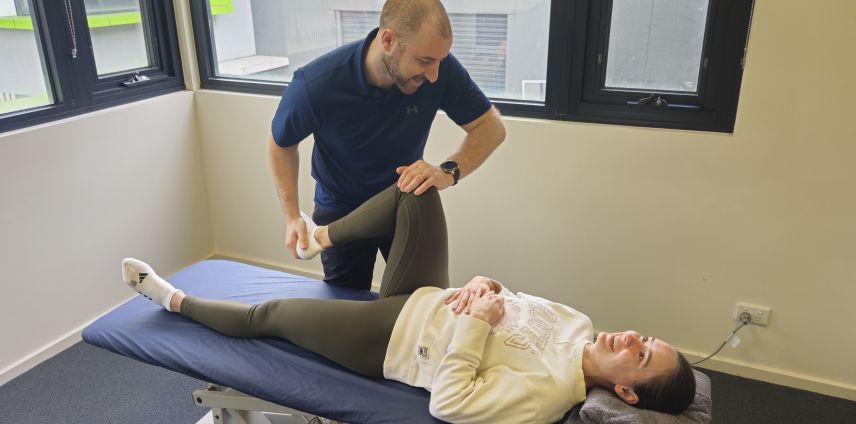
Knee pain is the most common reason people visit Adapt Sports Physiotherapy — and if you’re based in Chirnside Park or the surrounding area, you don’t need to travel far to get it properly assessed. We see patients from Chirnside Park, Croydon, Mooroolbark, Lilydale, Ringwood, and Montrose with knee complaints at every stage — from acute injuries to persistent pain that has been building for months.
The knee sits between the hip and the foot, meaning problems above or below it frequently contribute to symptoms. A thorough assessment of the whole lower limb — not just the knee itself — is usually the most reliable starting point.
General information only. This article does not replace individual assessment, diagnosis, or treatment. Outcomes vary between individuals.
Who Gets Knee Pain?
In our Chirnside Park clinic, knee pain is most common in:
- Footballers — from contact injuries, ACL tears, and meniscus damage during the season
- Runners — particularly patellofemoral pain and ITB-related conditions from training load
- Gym-goers and weightlifters — from patellar tendinopathy and overload during leg training
- Active adults aged 30–50 — where accumulated load meets the beginning of degenerative change
- People returning to sport after time off — whose knees haven’t rebuilt tolerance to full training demands
Common Causes of Knee Pain
1. Patellofemoral Pain (Kneecap Pain)
Patellofemoral pain describes discomfort around or behind the kneecap, and it’s one of the most common reasons active people come in for a knee assessment. It tends to show up after a change in training — a jump in running distance, an extra gym session added to the week, or a return to sport after a break — rather than out of nowhere. Hip strength, foot position, and quadriceps control all influence how the kneecap tracks, but a change in load is usually what tips things over.
Common signs:
- Aching around or behind the kneecap that started not long after a training change
- Discomfort during running, squatting, or climbing stairs that builds with volume and eases with rest
- Pain after prolonged sitting — sometimes called “theatre sign”
- Occasional grinding or clicking around the kneecap
What may help:
- Reviewing what’s recently changed in your running, jumping, or gym load
- Strengthening the hip, glute, and quadriceps to improve kneecap tracking
- Temporary load reduction while training is adjusted, not necessarily stopped altogether
- A structured progression back to full training as strength and tolerance improve
2. Patellar Tendinopathy (Jumper’s Knee)
Patellar tendinopathy involves irritation of the tendon connecting the kneecap to the shin bone, and it’s a regular presentation among the footballers, basketballers, and gym-goers we see. It typically develops when tendon load rises faster than the tendon can adapt to it — a heavier jumping schedule, a preseason increase in training days, or a new heavy leg session added to the week.
Common signs:
- Pain at the bottom of the kneecap, particularly when pressing on the tendon
- Pain during or after jumping, squatting, or running
- Stiffness and aching after training that warms up with activity
- Symptoms that have tracked a recent increase in jumping or leg-training volume
What may help:
- Reviewing the training change that likely triggered symptoms
- Load management — reducing jumping and heavy leg work temporarily, not stopping training altogether
- A progressive tendon loading program — the evidence-based approach for tendinopathy rehabilitation
- Addressing hip and quad strength deficits that increase tendon load
3. Meniscus Injuries
The menisci are two C-shaped cartilage structures inside the knee joint, acting as shock absorbers and stabilisers. In sport, they’re most often injured through a tackle, an awkward landing, or a sudden twist while the foot is planted — the kind of contact and direction-change moments that come up in football, netball, and basketball. Not all meniscus injuries require surgery — many respond well to structured physiotherapy.
Common signs:
- Pain on the inner or outer joint line of the knee, often following a specific incident
- Swelling that develops over hours after injury
- Locking, catching, or giving way in some presentations
- Difficulty fully straightening or bending the knee
What may help:
- Physiotherapy assessment to determine the nature and severity
- Load and activity management in the acute phase
- Progressive strengthening and movement rehabilitation, building toward the demands of your sport
- A graded return-to-play plan — with surgery considered only when conservative management has not been sufficient
4. ACL Injuries
ACL injuries are among the most significant knee injuries in sport, most commonly occurring in football, netball, and basketball from a sudden change of direction, an awkward landing, or contact during a game. ACL rehabilitation is one of our core clinical focuses at Adapt Sports Physiotherapy Chirnside Park.
Common signs:
- A pop or crack at the time of injury
- Rapid swelling within hours of the incident
- Significant instability or giving way of the knee
- Difficulty weight-bearing in the acute phase
What may help:
- Early physiotherapy assessment to guide acute management and plan a safe path back to training
- A structured ACL rehabilitation program — whether surgical or non-surgical management is chosen
- Criteria-based return to sport to reduce re-injury risk
For a detailed overview, visit our ACL Rehabilitation page.
5. ITB Syndrome
ITB syndrome is one of the most common overuse injuries we see in runners. The iliotibial band runs along the outer thigh from the hip to the knee, and it typically flares up after a change in running training — more kilometres added per week, a new hill session, or a return to running after time off — producing pain on the outer side of the knee.
Common signs:
- Sharp or burning pain on the outer knee during running
- Pain that comes on at a consistent point in a run — often 10–15 minutes in
- Symptoms that ease with rest but return when running resumes
- Tenderness on the outer knee when pressed
What may help:
- Identifying what actually changed in your running training before symptoms started
- Temporary reduction in running volume
- Hip and glute strengthening — weakness here is a major contributing factor
- Reviewing running load and training structure
- Gradual return to running with a structured progression plan
When Should You See a Physio for Knee Pain?
Physiotherapy assessment is likely to be useful if your knee pain is:
- Persisting beyond 1–2 weeks without clear improvement
- Swollen — particularly if swelling came on rapidly after injury
- Associated with locking, giving way, or significant instability
- Limiting sport, training, or daily activities like stairs and squatting
- Recurring — settling and returning in a familiar pattern
- Following a contact injury, sudden twist, or fall
If you’ve had a significant knee injury with rapid swelling and can’t weight-bear, seek assessment promptly — either with a physiotherapist or your GP.
For more detail, visit our Knee Pain Physiotherapy page.
Knee Pain Physiotherapy in Chirnside Park
Adapt Sports Physiotherapy is located in Chirnside Park and sees patients from across the Yarra Valley and Maroondah corridor — including Croydon, Mooroolbark, Lilydale, Ringwood, and Montrose — for knee pain assessment and rehabilitation, including ACL rehabilitation, tendinopathy, and return-to-sport programs. If knee pain has come on after football, see our guide to knee pain after football. For patients in Croydon, we also have a dedicated knee pain in Croydon resource.
Book an appointment online or call us on (03) 4063 3520.
Frequently Asked Questions
Can I keep training with knee pain?
In many cases yes, with appropriate modifications. The right approach depends on the cause — some conditions respond well to load reduction and exercise modification while others require more significant rest from aggravating activity. A physiotherapy assessment can guide what’s safe to continue. (General information only.)
Do I need a scan for knee pain?
Not always. Many knee conditions can be assessed and managed clinically without imaging. Scans are typically recommended when there are specific indicators — significant trauma, rapid swelling, or failure to improve with conservative management. Your physiotherapist or GP can advise. (General information only.)
How long does knee pain take to recover?
This varies considerably depending on the cause. Patellofemoral pain and ITB syndrome often improve within 6–12 weeks with appropriate rehabilitation. Tendinopathy typically requires a longer progressive loading program. ACL rehabilitation is a 9–12 month process for return to sport. (General information only.)
Do I need a referral to see a physio for knee pain in Chirnside Park?
No referral is required to book at Adapt Sports Physiotherapy. You can book directly online or by phone. (General information only.)
General information only — this article does not replace individual assessment, diagnosis, or treatment. Outcomes vary between individuals.